6 ‘Der Sturm’ – Edited Correspondence
The website https://sturm-edition.de/ serves as a portal for the work with sources concerning the avantgardist “STURM” enterprise that began with the founding of the journal of the same name in Berlin in 1910, by Herwarth Walden, and the subsequent founding of an art gallery, a theatre, and a publishing company that achieved international importance. Besides Walden other actors were a part of the enterprise and by summer 2026 179 letters by three different artists written to Walden were available in the portal. In addition to that, the journal, exhibition catalogues, yearbooks, publisher’s documents and further sources such as posters, photographs and invitations have been digitised.
Go to the homepage and read the brief description of the letters, people and places, to get a first impression of the material. Then click on the letter section and look at letter number 8, from Franz Marc to Herwarth Walden.
As you can see, the letter has not only been digitised, i.e. transformed into a digital image which you can look at via an external viewer, but also edited in historical-critical mode and encoded in XML following the TEI P5 guidelines.
What does that mean and why is it important for our work as historians?
In an historical-critical edition you do not produce a simple rendition for accessible reading as you are used to, for instance, from the way text is presented in a novel. Additional material, relevant for better understanding the text, is consulted and given as information in a so-called critical apparatus. For example, sources that the author has used as templates for certain passages are mentioned, or events that influenced the text are referenced. Named entities such as persons, places, works etc. are explained and commented on. The text itself is reproduced as close to the original as possible, orthographical or grammatical mistakes are not corrected, and usually extratextual elements such as crossed-out or underlined text is marked in some way.
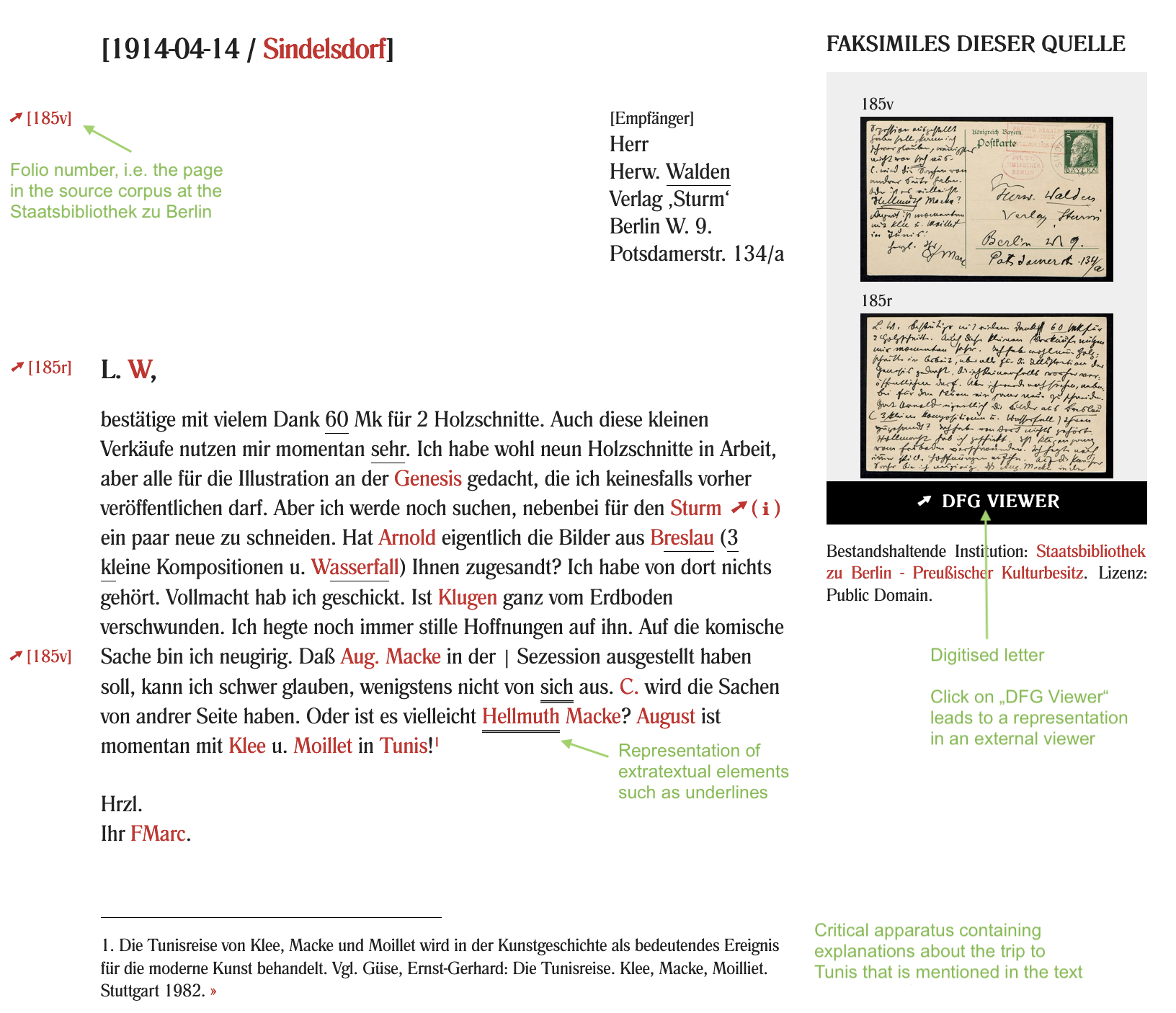
The precise way in which the editors proceeded – this is different from edition to edition – is laid out in the editorial principles. For the sources in the STURM project there are different principles for the different genres of sources. Those for the letter edition can be found here.
An encoding in XML means that a text file has been encoded with Extensible Markup Language, meaning that structures within the text have been marked with previously defined signs, so that they can be interpreted by both humans and machines. Somewhat commoner is HTML, Hypertext Markup Language, a language for the tagging of electronic documents. The principles are similar. Textual elements are marked with an opening and a closing tag, for instance<salute>Hrzl.</salute>,
in order to signalise that the salutation in a letter (as in letter 8, see above) is exactly that, a salutation. That has the benefit, that you do not have to search for specific terms if you are interested in different forms of salutations, but can search for the appropriate element <salute>, and not only you, but the machine too. We will come back to that. First we’ll look at the letters on the website.